
A fellow named Carl has subscribed to my blog. He is a Christian, and has a blog called “Considering the Bible”. I asked him why he followed my blog, and this was his response (BTW, memes at the bottom):
“I noticed you are an athiest and I want to understand not only why someone would choose that life, but also how that choice effects a person in their day to day life. Hence your blog is if interest to me.”
So I thought I’d write a bit about how being an atheist affects my everyday life.
Well, I don’t go to church. I don’t pray. I don’t say “bless you” if someone sneezes. I spend time showing how the claims of religions are harmful nonsense on social media.
Other than that, a Christian would have no idea that I’m not a Christian. I ride the bus. I go to work. I buy groceries. I enjoy being with my spouse and cats. I garden. I do laundry. I donate to charities.
Here in the US, Christianity is often equated with being “good”, being kind, being conscientious, being responsible, etc. Happily, Christianity has no lock on these things, and the vast majority of humanity have these qualities. I as an atheist don’t go around kicking puppies and punching old ladies, nor do I buy special atheist groceries or wander around insisting nothing has meaning (atheism doesn’t equate to nihilism). I have much the same morals as the rest of humanity. I just know that these morals are entirely subjective, based on empathy and self-interest.
As for Carl’s first question, I didn’t choose to be an atheist. I became an atheist since there is no evidence for Christianity or any other religion. I can’t keep believing in something that has nothing to support it.








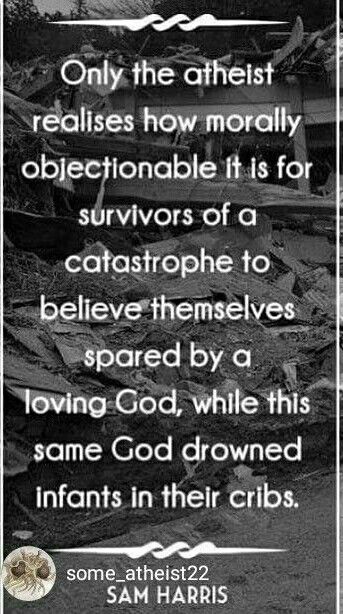

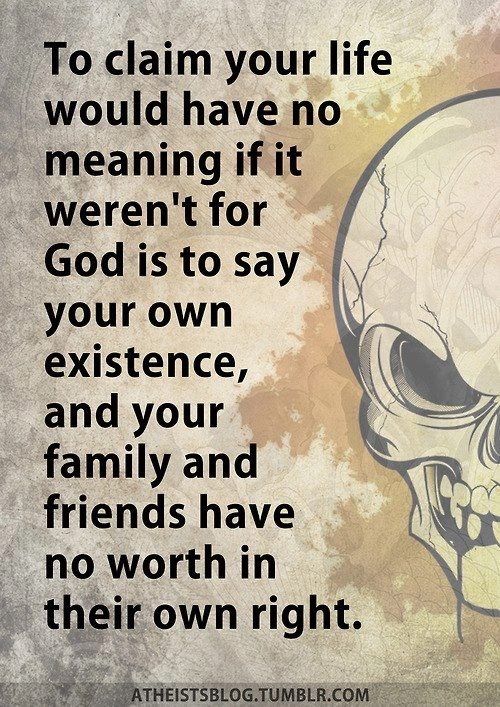
 Club Schadenfreude
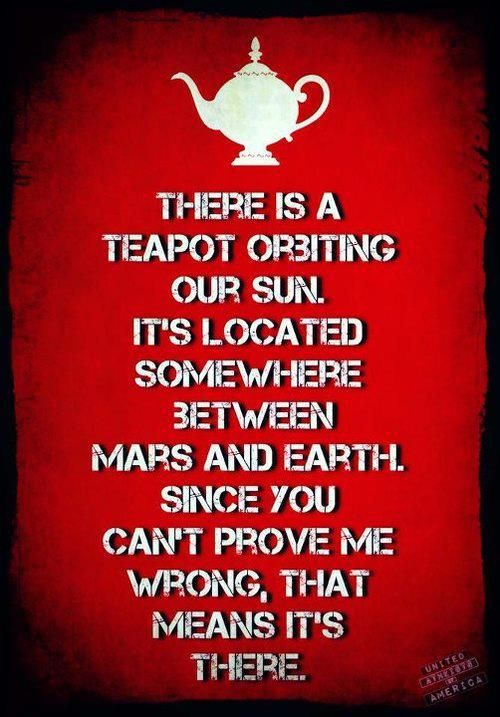
I like the teapot orbiting. And Christian morals fluctuate depending on who said what about the Bible and who the sheep follow.
LikeLike
russell’s teapot is one of my favorite arguments when it comes to showing how declaring something doesn’t make it exist.
LikeLiked by 1 person
My Atheism came all at once; I was playing with the concept of “inner thought” (one of those things, you know) and it suddenly dawned on me that the difference between religion and that was where you placed the focus: instead of praying ‘UP” I was praying to some kind of inner self, and at that moment something shifted. Belief was looking in, not looking out. Never looked back. And I don’t have to get dressed up on a sunday morning to go to church. =)
LikeLiked by 2 people
Great response!
I also do not tell people I will pray for them. I do not ask what church others go to or if they have a “church home.”
But my answer to “why” is that not only is it not a “Life” or lifestyle. But the main reason I identify as atheist is because I have decided that those folks who tell me that God is this or that are wrong. I have decided and am quite convinced, all religion notwithstanding, that no god exists. Not one of the claimed five thousand is or was real.
One day I identified as a believer. Then one day I no longer did. Other than the trappings of my association with a religion, nothing is any different except that I am older.
LikeLiked by 1 person
aren’t we all. 🙂 just how can I hurt myself sleeping?
LikeLiked by 2 people
This topic is very interesting to me. I, like many other atheists, did not set out to become an atheist per se; it was a result of my not finding “answers” in Catholicism, then trying some other form of Christianity, then researching the Bible, myself looking for something, (whatever that was, I am not sure). Of course, this resulted in more questions then answers and exposed the Bible to a level of scrutiny I had never subjected it – or myself – to before and it resulted in my losing my belief completely.
I must say though that there was an immediate feeling of emptiness, like all of a sudden there was no one having over us anymore. the universe seemed empty for a period.
LikeLiked by 2 people
During my last year as a practicing (or any other kind of) Catholic I was President of the Parish Council of a large parish. At a meeting to present information and to talk with candidates for council membership from a practical and “spiritual” perspective, one man asked me if I thought such participation would increase one’s faith or make a person (me?) a better catholic. I said, “I am sorry to tell you this, but I am the wrong person to ask.”
LikeLiked by 1 person
yep, it’s hard to leave such intoxicating ideas like someone is looking after you.
LikeLiked by 1 person
I thought of all the prayers and “conversations” I had with god, saints, my “guardian angel”, etc. over the many years! Now I no longer believe religion should be taught to children under a certain age, maybe 12, at least until they have an understanding of what they’re being asked to believe. Pre-school and Kindergarten is out of the question now; we had nuns, priests, and parents all feeding us this nonsense and, of course, we believed every word.
LikeLike